About Flange Nut
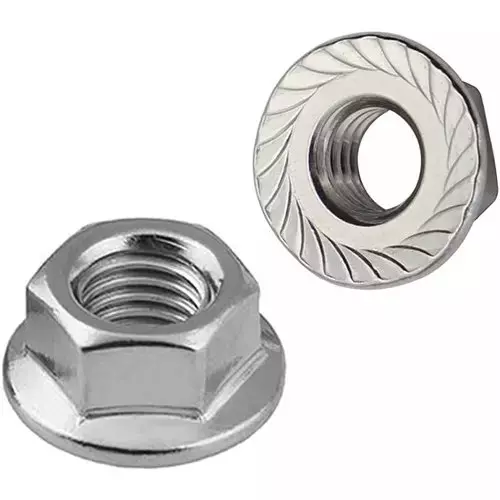
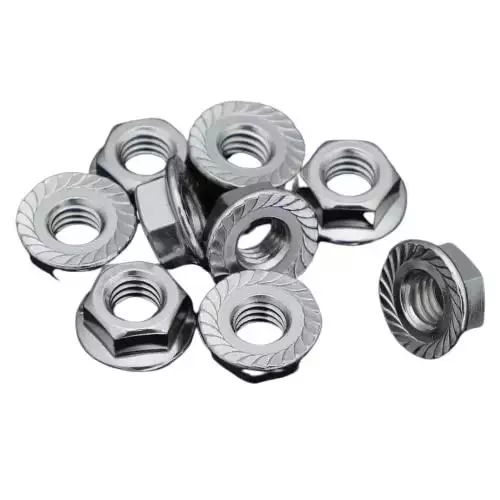
These stainless steel serrated flange nuts, commonly known as flange nuts, provide secure fastening with integrated locking serrations. Designed for industrial applications, they ensure vibration resistance and reliable assembly.
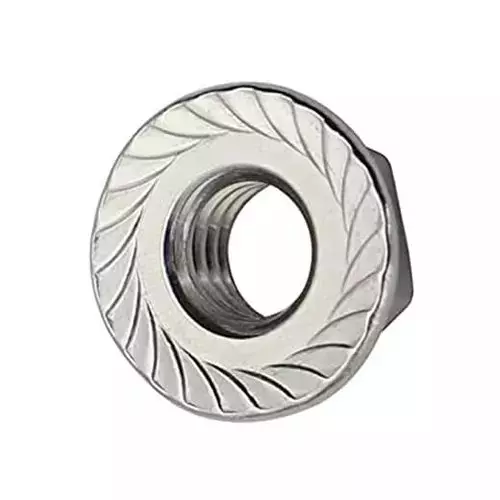
Superior Anti-Loosening DesignThe unique radial-serration under the flange of these nuts effectively locks the fastener in place by biting into the mating surface, resisting loosening from vibration or rotation. This makes them ideal for dynamic applications in automotive, machinery, and industrial equipment where maintaining joint integrity is critical.
Versatile and Durable Material ChoicesManufactured from stainless steel (A2-70/A4-70) or carbon/alloy steel, these flange nuts offer excellent corrosion resistance and robust tensile strength (minimum 700 MPa). Material and surface treatment options like passivation or zinc plating further enhance durability, ensuring reliable performance even in challenging environments.
Easy Installation and ReusabilityThe integrated washer-like flange and hexagonal head design allow for straightforward installation using standard wrenches. These nuts are fully reusable without compromising their locking effectiveness, making them practical and economical for maintenance and assembly operations in diverse industries.
FAQ's of Flange Nut:
Q: How does the radial serration on this flange nut prevent loosening?
A: The radial serration bites into the mating surface, increasing frictional resistance and preventing the nut from backing out due to vibration or rotational forces. This mechanical locking feature is especially effective in dynamic and high-load environments.
Q: What applications are most suitable for these radial serrated flange nuts?
A: These nuts excel in automotive, machinery, construction, and electronics industries where vibration resistance and secure fastening are essential. They are ideal for assemblies requiring robust performance and minimal maintenance.
Q: When should I choose stainless steel over carbon steel for flange nuts?
A: Choose stainless steel (A2-70/A4-70) for enhanced corrosion resistance, particularly in outdoor or humid environments, or where RoHS compliance is necessary. Carbon/alloy steel variants are suitable for dry or less corrosive settings where higher strength may be prioritized.
Q: Where can I source these flange nuts and what packaging options are available?
A: As an importer, manufacturer, supplier, or trader, we offer these flange nuts in box, packet, or bulk packaging. Contact us for supply in quantities that match your project requirements and preferred packaging type.
Q: What is the process for installation and reuse of these flange nuts?
A: Install the nut using a standard hex wrench, ensuring the serrated flange seats firmly against the surface. These nuts can be reused multiple times without loss of locking ability, making them ideal for maintenance or adjustable assemblies.
Q: What are the benefits of using this integrated serrated flange nut over a standard hex nut with a washer?
A: This nut combines the locking action of serration with force distribution of a flange, reducing the number of components and installation steps. It offers superior vibration resistance, consistent locking performance, and saves assembly time.







 Send Inquiry


 Send Inquiry
 Send Inquiry
 Send SMS
